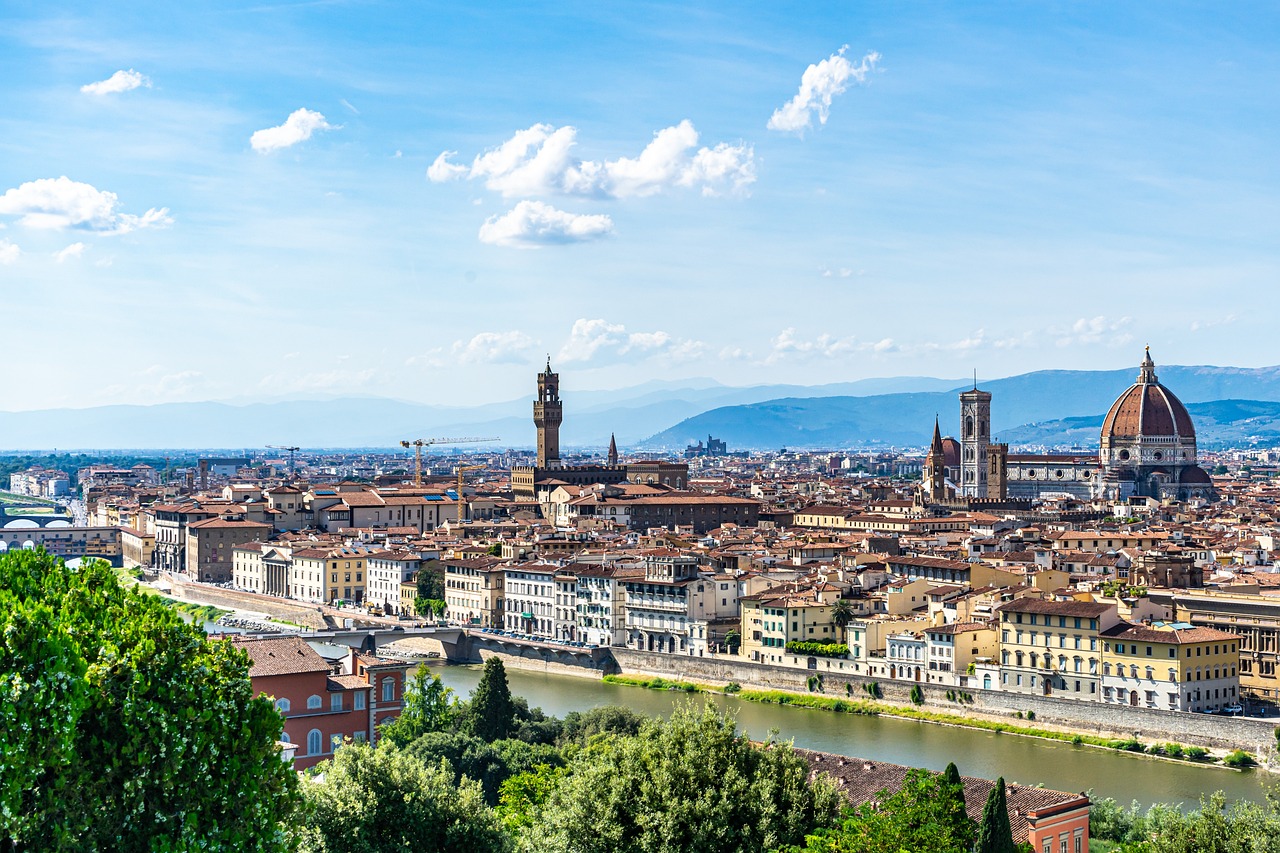
💡 About Florence
Florence, Firenze in Italian, is the city where the Renaissance was born and where, across a period of roughly two centuries from the 14th to the 16th century, European art, architecture, literature, philosophy and science underwent the most profound transformation in their history — a transformation so total and so generative that it reshaped the entire Western world's understanding of what human beings were capable of creating. The Uffizi Gallery, built originally as the administrative offices (uffizi) of Cosimo I de' Medici and converted into a museum by the Medici family in 1581 — making it one of the oldest art museums in the world — houses a collection so dense with masterpieces that visitors frequently experience what has been clinically described as "Stendhal syndrome": dizziness, confusion, rapid heartbeat and even hallucinations triggered by an overload of aesthetic stimulation, particularly in the rooms devoted to Botticelli's Birth of Venus and Primavera. Michelangelo's David, carved from a single 5.17-metre block of Carrara marble between 1501 and 1504 after Michelangelo was commissioned by the Florence Cathedral workshop to complete a project that two previous sculptors had abandoned, is considered the supreme achievement of Renaissance sculpture and arguably of human artistic endeavour — the tension visible in the turned head, the set jaw, the outsized right hand and the expression of concentrated readiness captures a psychological complexity that had not been attempted in stone since the ancient Greeks.
The Medici family, who dominated Florence politically, commercially and culturally from the 13th to the 18th century, were the greatest art patrons in Western history: Cosimo de' Medici (1389–1464) founded the Platonic Academy, patronised Donatello, Ghiberti and Brunelleschi; Lorenzo the Magnificent (1449–1492) supported the young Michelangelo, Leonardo da Vinci, Botticelli and Poliziano in his household; and successive Medici popes (Leo X and Clement VII) brought Renaissance culture to Rome. Florence's Cathedral (the Duomo), dedicated to Santa Maria del Fiore and begun in 1296, was given its extraordinary octagonal dome by Filippo Brunelleschi between 1420 and 1436 — a feat of engineering so audacious that no one, including Brunelleschi himself, had previously known if it was possible; with a span of over 45 metres and a height of 116 metres, it remains the largest brick dome ever constructed and is still the most prominent feature of the Florentine skyline over 500 years later. The Arno River, which bisects Florence and floods spectacularly every generation or so (the last major flood, in November 1966, destroyed or damaged over three million artworks and manuscripts), is crossed at its most historic point by the Ponte Vecchio, which has spanned the river at this location since at least 996 AD; the current bridge, rebuilt in 1345, is lined with goldsmiths' and jewellers' shops that replaced the original butchers' shops in 1593 on the orders of Grand Duke Ferdinand I, who found the smell of meat offensive when he crossed on the Vasari Corridor above.
The Vasari Corridor itself — an elevated passageway nearly a kilometre long, designed by Giorgio Vasari in just five months in 1565 to allow the Medici to move between the Palazzo Vecchio and the Pitti Palace without descending to street level — is one of the great hidden secrets of Florence, a secret corridor hung with hundreds of self-portraits that snakes above the heads of oblivious shoppers and tourists below. Florence's artisan tradition — leather goods handmade on the Santa Croce neighbourhood's family workshops, gold jewellery from the Ponte Vecchio, bookbinding using traditional Florentine marbled paper, perfumery from the Officina Profumo-Farmaceutica di Santa Maria Novella (the world's oldest pharmacy, founded by Dominican monks in 1221) — represents a continuity of craft that connects the present city directly to its Renaissance past.
⭐ Traveller Ratings & Tips
🏆 City Rankings →Rate Florence
⭐ Known For
🏛️ Top Attractions
- Uffizi Gallery
- Florence Cathedral (Duomo)
- Galleria dell'Accademia (David)
- Ponte Vecchio
- Piazzale Michelangelo
- Pitti Palace
- Boboli Gardens
🍽️ Local Food
- Bistecca alla Fiorentina
- Ribollita
- Lampredotto
- Pappardelle al cinghiale
- Cantuccini with Vin Santo
- Schiacciata
- Chianti Classico wine
🍽️ Where to Eat in Florence
See all 4 →A 19th-century iron-and-glass market with a lively first-floor food hall.
📍 View on MapsFlorence's famous panini window — enormous stuffed schiacciata sandwiches, hence the queues.
📍 View on MapsA lunch-only, shared-table trattoria beloved for its Florentine steak and hearty Tuscan cooking.
📍 View on MapsA more local market than Centrale, ringed by no-nonsense trattorias.
📍 View on Maps