💡 About Helsinki
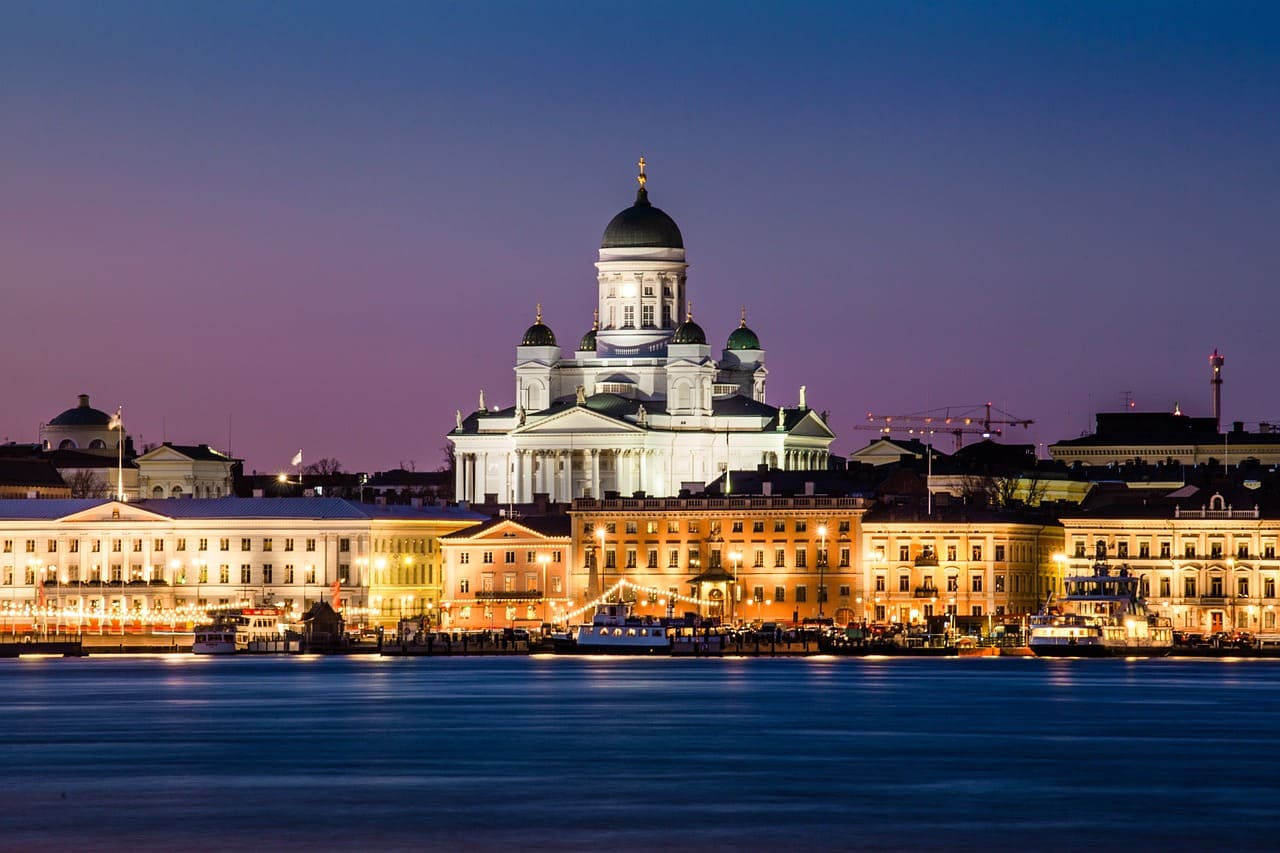
Helsinki, the northernmost capital city in the European Union, sits at the tip of a granite peninsula on the Gulf of Finland with over 300 islands within its municipal boundaries and a relationship with the sea — its harbour, its island fortresses, its ferries and its archipelago — that defines the city's character as completely as the Seine defines Paris or the Thames London. Finland's capital was founded by the Swedish king Gustav Vasa in 1550, but remained an insignificant town until 1812, when Tsar Alexander I of Russia — who had just seized Finland from Sweden — decided to move the capital from Turku (too close to Sweden for Russian comfort) to Helsinki (conveniently close to St. Petersburg for Russian supervision); the city was redesigned from scratch by the German-born architect Carl Ludwig Engel in a neoclassical style modelled on St.
Petersburg, producing the ensemble of Senate Square, the Helsinki Cathedral and the surrounding government buildings that still form the city's majestic heart. Helsinki is the capital of a nation that has consistently topped global rankings for happiness, education quality, press freedom, absence of corruption, coffee consumption (the highest per capita in the world) and — particularly significant in a country where winter means four hours of daylight — resilience; the Finnish concept of sisu, roughly translatable as inner strength, grit and stoic determination in the face of adversity, is considered the defining national characteristic. The sauna is not merely a Finnish pastime but a cultural and quasi-religious institution: there is approximately one sauna for every two Finns (a total of over three million), public saunas (like the celebrated Allas Sea Pool and Löyly on the waterfront) are social centres, business meetings are traditionally conducted in saunas, and the Finnish government has a sauna in which it negotiates with foreign dignitaries — the sauna's capacity to equalise social hierarchies (everyone is naked; there is no obvious rank) makes it a powerful social leveller.
Design is Finland's most celebrated cultural export and Helsinki its world capital: Alvar Aalto, who designed furniture, glassware, ceramics and buildings of timeless elegance, was the most influential Scandinavian architect of the 20th century; Marimekko's bold graphic fabrics have been in continuous production since 1951; Iittala's glassware (including the Aalto vase and the Kartio tumbler) is in collections worldwide; and Arabia's ceramics are Finnish domestic staples of beauty and practicality that perfectly embody the Nordic design philosophy that the everyday object should be a pleasure to use. Suomenlinna (Sveaborg in Swedish), the UNESCO-listed sea fortress built by Sweden on a cluster of islands guarding the approach to Helsinki harbour between 1748 and 1772, then expanded by Russia after 1808, is one of the largest sea fortresses in the world; it is now home to approximately 800 permanent residents, several museums, restaurants and an internationally renowned contemporary art community, and is accessible by a 15-minute ferry ride from the Market Square. The Finnish relationship with nature is profound and non-negotiable: the concept of jokamiehenoikeus (every man's right) gives all people, regardless of land ownership, the right to walk, ski, pick berries and mushrooms and camp temporarily anywhere in Finland's forests and countryside — a legal right that reflects a national conviction that access to nature is not a privilege but a fundamental human necessity.
During the white nights of midsummer, when the sun barely sets for several weeks and the archipelago glows with an amber light that lasts through the night, Helsinki's residents abandon the city en masse for the over half a million summer cottages (mökki) that dot the lakeshores of the Finnish countryside — a national migration to simplicity and nature that represents the Finnish soul expressing itself most completely.
⭐ Traveller Ratings & Tips
🏆 City Rankings →Rate Helsinki
⭐ Known For
🏛️ Top Attractions
- Helsinki Cathedral & Senate Square
- Suomenlinna Sea Fortress
- Market Square (Kauppatori)
- Design District
- Temppeliaukio Rock Church
- Ateneum Art Museum
- Oodi Central Library
🍽️ Local Food
- Karjalanpiirakka (Karelian pasty)
- Lohikeitto (salmon soup)
- Sautéed reindeer
- Ruisleipä (dark rye bread)
- Korvapuusti (cinnamon roll)
- Salmiakki (salty liquorice)
- Lonkero (gin long drink)