💡 About Munich
Munich, Bavaria's white-and-blue capital, embodies a contradiction that visitors find endlessly fascinating: it is simultaneously one of Germany's most tradition-bound cities — where the dirndl and lederhosen are worn without irony, where Weisswurst must by custom be eaten before noon, where beer halls serving one-litre steins have operated without interruption for centuries — and one of Germany's most dynamic economic centres, home to BMW, Siemens, MAN, Allianz, Munich Re and a thriving technology sector that has earned it the nickname "Silicon Valley of Germany." Oktoberfest, the world's largest beer festival, has been held on the Theresienwiese fairground since 1810 — when it was originally celebrated as a horse race in honour of Crown Prince Ludwig's wedding — and has evolved over two centuries into an event of staggering scale: across 16 days in late September and early October, six to seven million visitors from around the world consume over 7 million litres of beer (brewed exclusively by the six Munich breweries: Augustiner, Hofbräu, Hacker-Pschorr, Löwenbräu, Paulaner and Spaten), 500,000 roast chickens and 100 oxen. The Englischer Garten (English Garden), created between 1789 and 1792 on the orders of the Elector Karl Theodor, is one of the world's largest urban parks — at 370 hectares it significantly exceeds Central Park in New York — and contains within its wooded expanse a Japanese tea house, a Chinese pagoda beer garden serving thousands simultaneously, and most extraordinarily, the Eisbachwelle: a standing wave on the Eisbach stream where, remarkably, surfers ride year-round in the middle of the city, often in thick wetsuits in February, attracting spectators who line the banks to watch in bemused admiration. The BMW Museum and adjacent BMW Welt (BMW World), two of Germany's most visited tourist attractions, celebrate over 100 years of automotive engineering in a building complex of striking contemporary architecture near the Olympic Park — the Welt's double-cone structure, designed to evoke a cloud, serves simultaneously as a delivery centre where customers can collect their new BMWs, an exhibition space, an events venue and a demonstration of the brand's commitment to spectacular architecture.
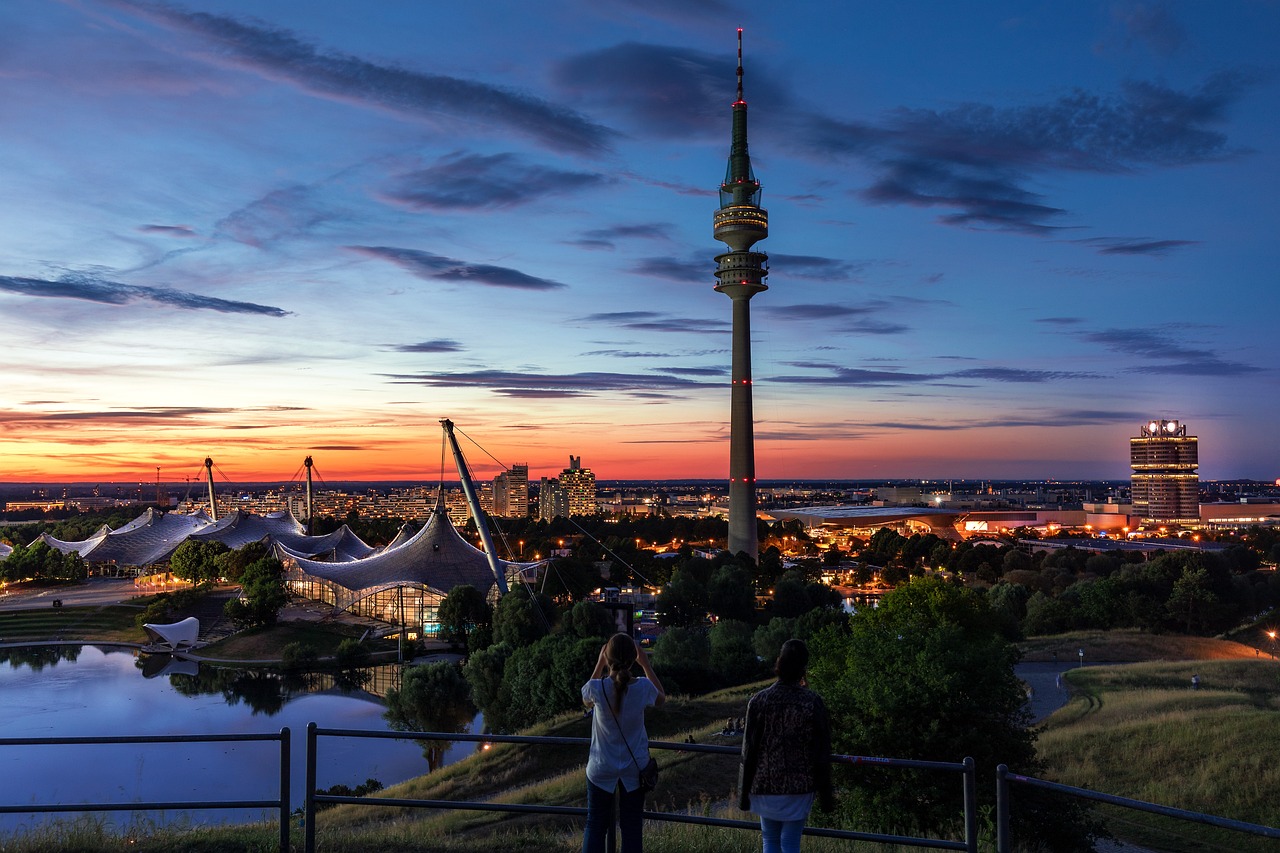
The Olympic Park, constructed for the 1972 Summer Olympics on a former World War II rubble dump, introduced a revolutionary design by architects Günther Behnisch and Frei Otto: a sweeping acrylic roof suspended from masts by cables created an organic landscape quite unlike any previous sports facility, and the park today serves as Munich's premier outdoor events venue, with the Olympic Stadium, swimming hall and cycling track repurposed for concerts, festivals and recreation. Munich was the birthplace and early power base of the Nazi movement: the Beer Hall Putsch of 1923, Hitler's failed coup attempt, was launched from the Bürgerbräukeller in Munich; the NSDAP was founded here; and the Documentation Centre for the History of National Socialism, opened in 2015, occupies the very location of the former "Brown House" party headquarters, confronting the city's darkest history with unflinching directness. The Marienplatz, Munich's central square and its social and commercial heart since 1158, is dominated by the New Town Hall (Neues Rathaus), a neo-Gothic fantasy completed in 1908 whose Glockenspiel (carillon) enacts two stories from Munich's history — a jousting tournament from 1568 and the dance of the Schäffler (coopers) that celebrated the end of a plague in 1517 — twice daily at 11am and noon, drawing thousands of onlookers who crane their necks upward for a five-minute performance that has delighted and slightly disappointed visitors in equal measure for over a century.
⭐ Traveller Ratings & Tips
🏆 City Rankings →Rate Munich
⭐ Known For
🏛️ Top Attractions
- Marienplatz & Glockenspiel
- English Garden
- Deutsches Museum
- Nymphenburg Palace
- BMW Museum
- Viktualienmarkt
- Neuschwanstein Castle (day trip)
🍽️ Local Food
- Weißwurst (white sausage)
- Pretzels (Brezn)
- Schweinshaxe (pork knuckle)
- Obatzda (cheese spread)
- Schnitzel
- Strudel
- Weissbier