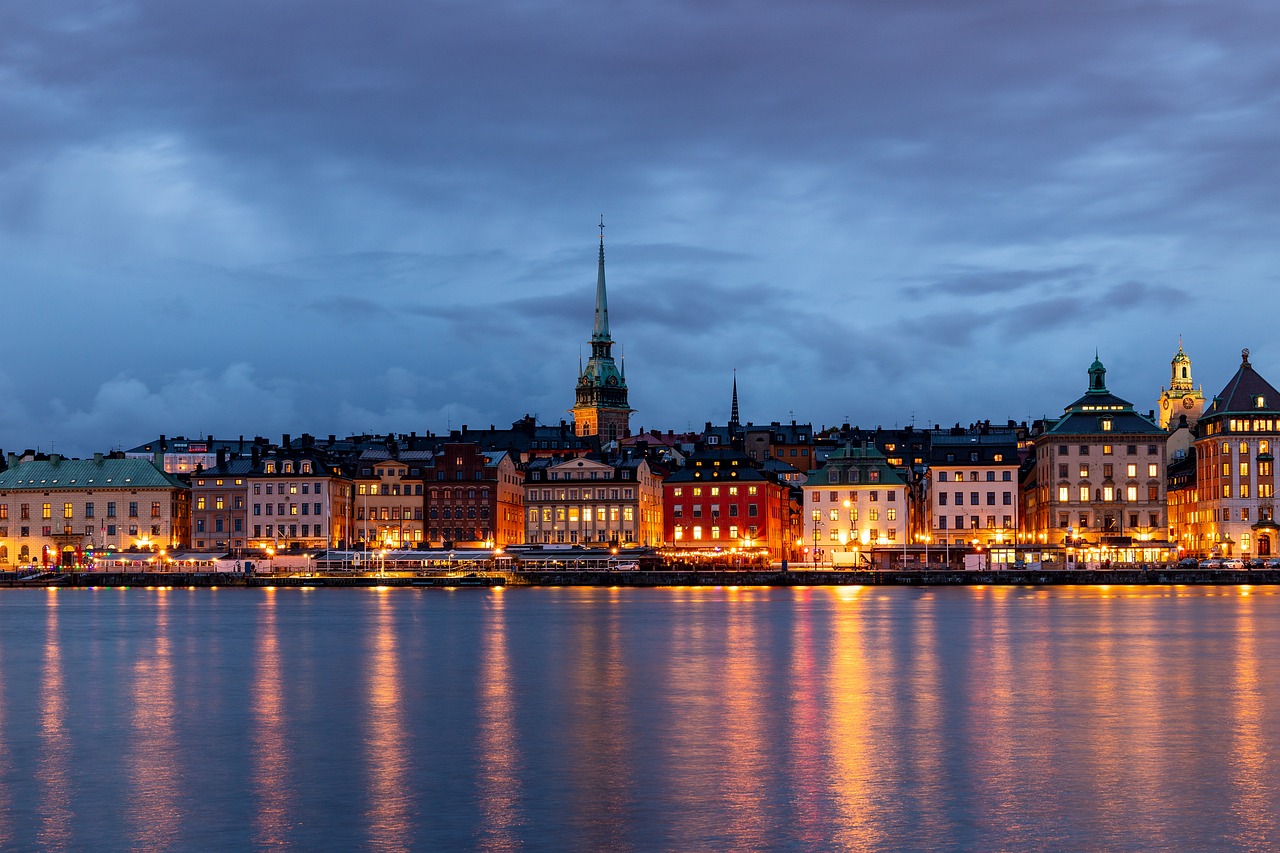
💡 About Stockholm
Stockholm, built across fourteen islands at the point where the freshwater of Lake Mälaren flows into the saltwater of the Baltic Sea, is a city of extraordinary physical beauty — its medieval Gamla Stan glows golden at sunset, its waterways reflect the northern sky, and the surrounding archipelago of over 24,000 islands, islets and skerries extends 80 kilometres into the Baltic and provides a wilderness playground that Stockholmers access by ferry throughout the summer. The Swedish capital was founded in the mid-13th century, and Gamla Stan (Old Town) preserves its original medieval street plan almost intact — the narrow cobblestone lanes, some barely a metre wide, lead past painted Renaissance merchants' houses to the Royal Palace, the largest palace in the world still used as the official residence of a reigning monarch, with over 600 rooms housing the royal court, state apartments and three museums. The Vasa Museum is home to the world's only almost completely preserved 17th-century warship: the Vasa sank on her maiden voyage in August 1628, barely 1,300 metres from the wharf where she was built, capsizing and sinking within minutes in full view of thousands of horrified spectators on the Stockholm waterfront; she lay on the seabed in 32 metres of water for 333 years until her discovery in 1956 and salvage in 1961 — preserved by the cold, low-salinity waters of the Baltic — and is now displayed in an extraordinary purpose-built museum that receives over 1.5 million visitors annually.
Stockholm is a genuine world capital of sustainability: the city aims to be fossil-fuel-free by 2040 and has already eliminated coal from its energy mix entirely; 62% of Stockholm's residents commute by bicycle or public transport, the district heating network runs largely on waste heat and biomass, and the Hammarby Sjöstad neighbourhood, built on a former industrial wasteland and opened in 2000, became a global model for sustainable urban development. The Nobel Prizes — established by the will of Alfred Nobel, the Swedish inventor of dynamite who accumulated a vast fortune and died in 1896 apparently consumed by guilt over the destructive uses to which his invention had been put — are awarded in Stockholm every December 10th (the anniversary of Nobel's death) in a ceremony of considerable pomp in the Concert Hall; the Peace Prize alone is awarded in Oslo, as specified in Nobel's will. ABBA, whose four members met in Stockholm in the 1970s and went on to become the best-selling music act in history outside of The Beatles and Elvis Presley, have lent their name to the ABBA Museum on Djurgården island, where visitors can test their vocal abilities in a holographic performance with the virtual band.
The Stockholm Archipelago, accessible from the city by regular ferry services, offers a distinctive Swedish experience — the wooden boathouses and red-painted summer cottages (sommarstugor) that dot the islands have been the summer retreats of Stockholmers for over a century, and the tradition of the midsommar celebration, with its maypole, herring feasts and dancing until the midnight sun barely sets, is the centrepiece of the Swedish calendar. Scandinavia's design tradition — which gave the world IKEA's democratic furniture, Iittala's glassware, Marimekko's bold textiles, Volvo's safety innovations and a dozen other influential brands — has its capital in Stockholm, where the concept that everyday objects should be beautifully designed and accessible to all, not just the wealthy, has been a cultural value for over a century.
⭐ Traveller Ratings & Tips
🏆 City Rankings →Rate Stockholm
⭐ Known For
🏛️ Top Attractions
- Gamla Stan
- Vasa Museum
- ABBA Museum
- Skansen open-air museum
- Royal Palace
- Djurgården island
- Fotografiska photography museum
🍽️ Local Food
- Meatballs with lingonberry
- Smörgåsbord
- Gravlax
- Cinnamon buns (kanelbullar)
- Janssons frestelse
- Semla
- Surströmming