The 10 Most Beautiful Cities in the World: Landscape and Architecture
Some cities owe their appearance to the land and water around them as much as to their buildings. Cape Town's mountain edge, Sydney's harbour and Hong Kong's steep green backdrop make architecture part of a much larger composition. This worldwide selection brings together ten places where natural setting and built form explain one another, from Brazilian bays to Japanese foothills and a northern European harbour.
Beauty here is an editorial judgement, not an international award or a measurable city attribute. The entries explain what makes each setting distinctive and where that relationship becomes visible. For a continent-specific collection of viewpoints, see the European beauty selection. For a trip organised around a single unforgettable activity, the bucket-list experience guide provides another way to choose.
Mountains that give architecture a setting
1. Cape Town: a city beneath a broad mountain wall
In Cape Town, Table Mountain is an organising feature rather than a distant scenic accessory. Its highest point is 1,086 metres above sea level. From the lower city, that broad summit makes buildings seem small; from an authorised high viewpoint, the coastline and street pattern become the principal subjects. These two scales are the reason the city belongs in a setting-led selection.
The V&A Waterfront shows working harbour elements against the mountain, while Sea Point places the city beside an Atlantic promenade. Neither is a substitute for the other. The Table Mountain cableway is weather-dependent, so keep the high view as an option rather than the sole purpose of the visit. Cloud over the summit can also make a lower waterfront scene more distinctive, with the mountain partly revealed behind it.
2. Rio de Janeiro: bays, granite and long urban beaches
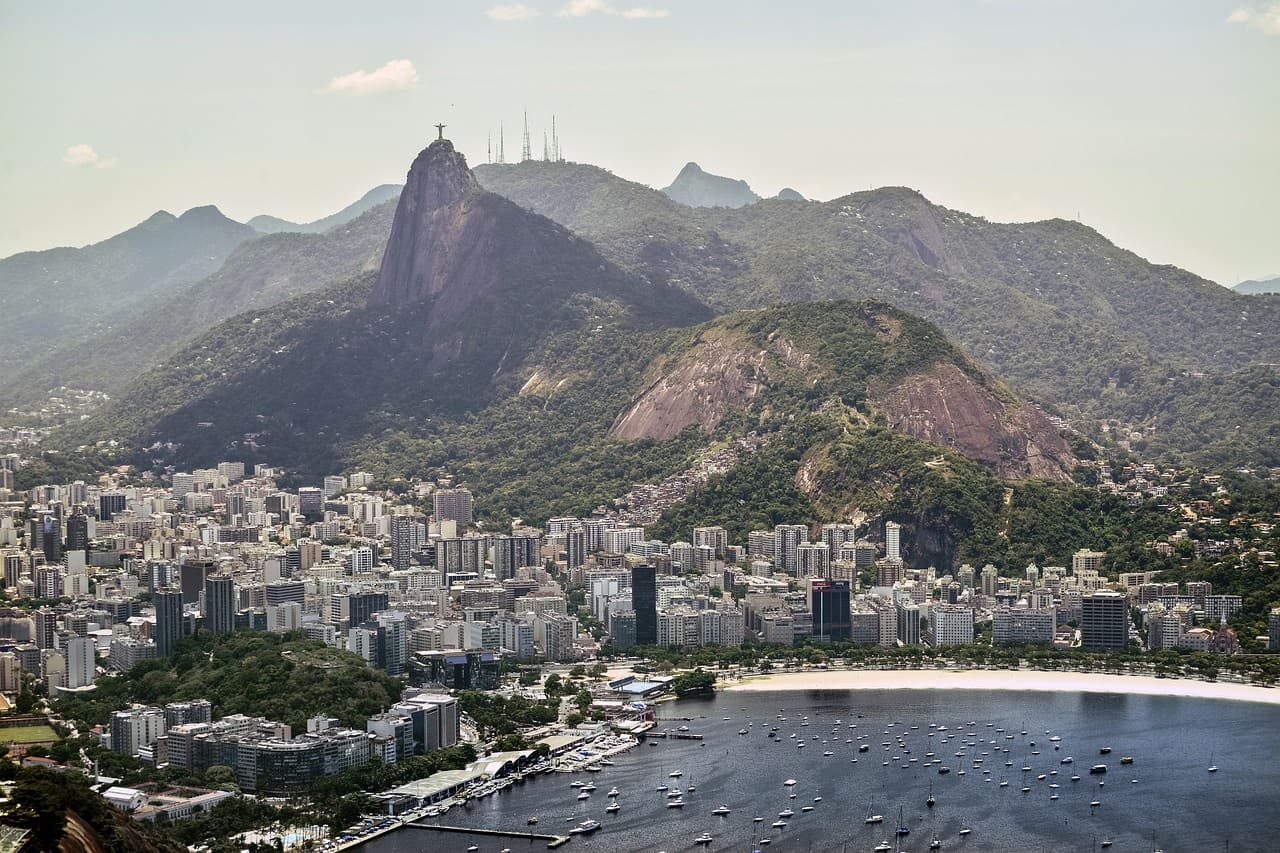
Rio de Janeiro has an unusually legible relationship between steep granite forms, buildings and water. Sugarloaf rises to 396 metres beside the entrance to Guanabara Bay. Its setting gives the harbour a different geometry from the Atlantic beaches at Copacabana and Ipanema. A view of one side of Rio does not show the whole city, and that variety is part of its visual appeal.
Look at the curve of Copacabana from a suitable public coastal position, then compare it with the bay's more enclosed water. The wave-pattern pavement is a close detail that connects the grand landscape with everyday walking. Organised transport to a chosen viewpoint is more sensible than wandering into unfamiliar hillside districts for an improvised photograph. Rio's beauty is not a reason to ignore local access conditions or government travel guidance.
3. Hong Kong: towers between harbour and green slopes
The skyline of Hong Kong is dramatic because there is little flat land between Victoria Harbour and the surrounding hills. From the Kowloon waterfront, the towers appear as a dense band beneath rising terrain. Victoria Peak reaches 552 metres, though visitor terraces and paths sit at different elevations. Avoid using that summit height as the height of every observation point.
Public waterfront space allows the relationship between ferries, water and buildings to remain visible. A harbour crossing changes that view gradually, unlike a single stationary panorama. The city's natural setting also extends beyond the towers to country parks and islands, but those require their own planning. For this article's purpose, the central harbour already explains why the built environment looks so concentrated and vertically layered.
Architecture that responds to water
4. Sydney: modern forms on an old gathering place
Sydney brings the Opera House and Harbour Bridge into a setting of coves, ferries and open water. The Opera House opened in 1973, designed by Danish architect Jørn Utzon. Its position at Bennelong Point, known as Tubowgule in its Aboriginal history, matters as much as the famous roof forms. The building is experienced from several waterfront directions, not just one standard postcard angle.
The Opera House's own history explains the project's development and cultural context. From the Royal Botanic Garden side, water separates the building from the surrounding city; from Circular Quay, the working harbour and arriving ferries come forward. A ferry journey towards Manly changes the scale again. These public and transport-based perspectives show a landmark as part of a living harbour rather than a detached architectural object.
5. Venice: buildings and lagoon belong together
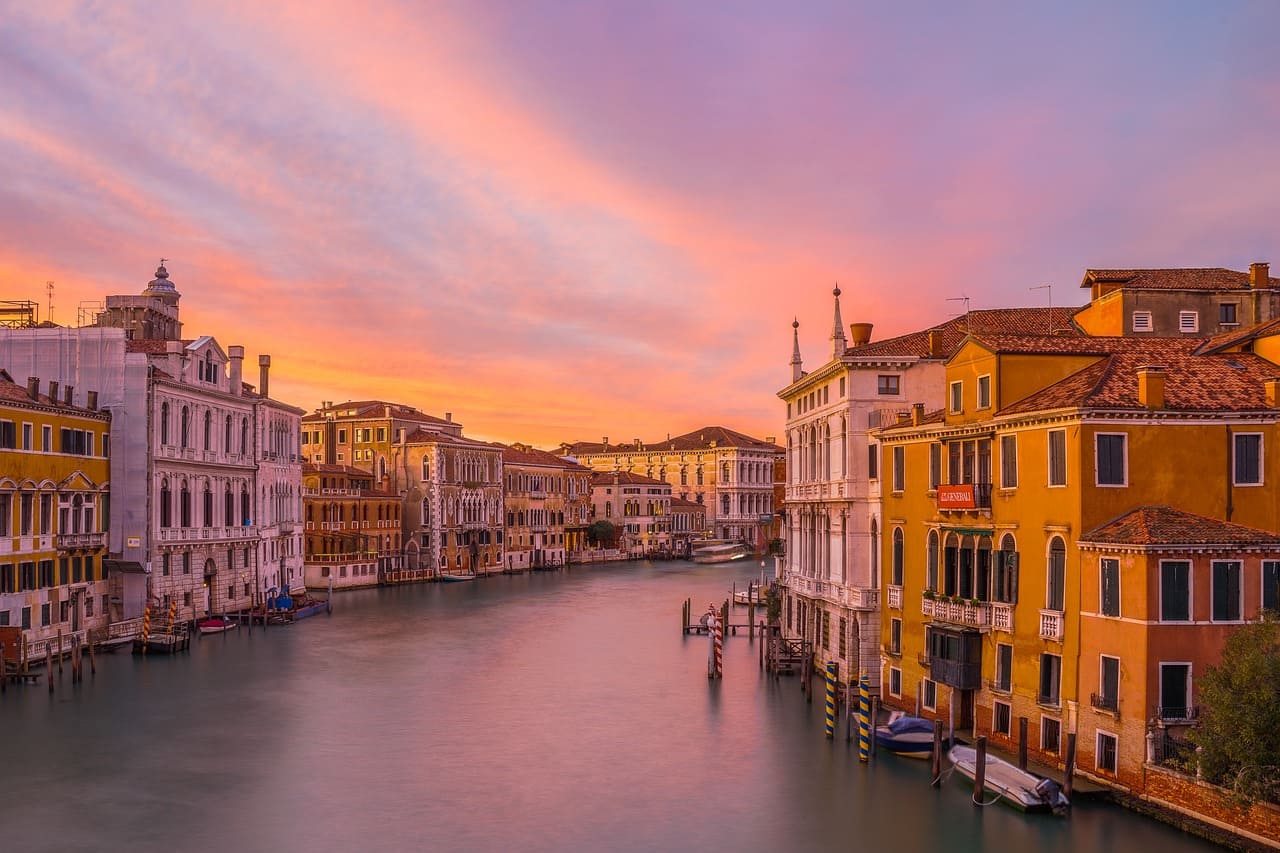
The fabric of Venice is inseparable from water. A palace façade, a narrow canal and a boat landing make sense together because the city developed around lagoon movement and trade. Venice and its Lagoon became a UNESCO World Heritage Site in 1987. Its appearance comes from this relationship, rather than from any claim that it is unchanged or universally the world's most romantic place.
The Grand Canal shows large-scale architecture along a transport corridor, while a smaller Cannaregio canal shows buildings at a more intimate scale. The lagoon's broader horizon is a third visual experience. Boat travel can help connect them, although wake, queues and ordinary service activity are part of the scene. Look for the meeting of stone steps and water: that edge often says more about Venice than another isolated dome photograph.
6. Istanbul: two shores around a busy waterway
Istanbul occupies a setting where the Bosphorus connects the Black Sea and the Sea of Marmara. Its European and Asian shores are both part of the city. Hagia Sophia was completed in AD 537, while the skyline also includes Ottoman mosques and contemporary buildings. The visual interest lies in these structures rising above a heavily used waterway, not in an imagined division between timeless and modern worlds.
A public ferry supplies changing views of shorelines, domes and neighbourhood hills. From the Golden Horn, the relationship between the historic peninsula and the water looks different again. Interior visits need their own arrangements, particularly at active religious buildings; a skyline view does not require entering them all. Istanbul's current regional travel context also deserves attention before booking, even when the city itself is outside named border exclusion zones.
River cities with readable silhouettes
7. Budapest: one river, contrasting banks
In Budapest, the Danube gives the city both separation and coherence. Buda's hills contrast with the flatter Pest bank. Parliament, completed in 1904, stands beside the river rather than hidden inside a dense street grid. From the opposite bank, its scale can be read against the embankment and the open water. That is a stronger description of the city than a photograph cropping away the river entirely.
The Chain Bridge opened in 1849 and provides another line through the setting. Hilltop views show the bridges as a sequence; lower walks let individual buildings dominate. Night illumination changes the scene, but daylight reveals the banks, vegetation and surface textures more clearly. Budapest earns its place through the way a major river makes contrasting urban forms understandable within one view.
8. Prague: the river beneath a hilltop complex
Prague combines a winding Vltava, a hilltop castle district and the smaller roofs of the old neighbourhoods below. Charles Bridge, begun in 1357, supplies a horizontal line below the hilltop buildings. From suitable riverside positions, the bridge becomes a foreground structure and the castle a distant layer. The result is not simply a collection of impressive buildings; the changes in elevation give the view its depth.
Letná offers a more expansive reading of the river's bends and successive crossings. At street level in Malá Strana, the hills are felt through inclines and sudden views between buildings. Keep those scales distinct rather than chasing every tower in one session. Prague's natural setting is gentler than Cape Town's, yet it performs a similar visual role: it explains where buildings sit and why their skyline has that shape.
Foothills and northern harbours
9. Kyoto: architecture with a hillside backdrop
Kyoto is framed by mountains on three sides, with Higashiyama's eastern slopes close to several well-known temple districts. The present Kiyomizu-dera main hall, dating from 1633, makes that hillside relationship especially clear. Its wooden stage is striking not only as a structure but as a place overlooking the city and trees below. The setting changes seasonally, without making cherry blossom or autumn colour guaranteed for a particular travel date.
At lower level, lanes around Higashiyama reveal rooflines, timber and stone against the hills. The Kamo River supplies a different, more open urban perspective. Temple gardens should be appreciated as designed cultural landscapes, not generic patches of nature. Stay on permitted routes and follow photography notices. Kyoto's beauty becomes clearer when buildings, gardens and terrain are observed together rather than collected as unrelated famous names.
10. Bergen: a harbour enclosed by rising ground
Bergen has a compact harbour frontage with hills close behind it. Bryggen's timber trading buildings are a UNESCO site, inscribed in 1979. Their repeated gables form a strong edge against the water. The larger setting becomes clearer from Fløyen, at 320 metres, where the harbour is seen as one part of a city following irregular land and shoreline.
Rain and low cloud are common parts of this landscape, not visual inconveniences that must be edited away. Wet surfaces strengthen colour; mist can separate hill layers. A close Bryggen view and a broad Fløyen panorama tell different stories about the same city. Visitors who cannot or do not want to go uphill can still understand the setting from the harbour and lower public streets.
Choosing a setting you actually want to experience
If mountains are the attraction, Cape Town and Rio offer a very different visit from Venice or Budapest. If water and architecture matter more, Sydney and Istanbul provide changing perspectives through ordinary boat movement. The destination finder can help narrow those preferences, while the best-time tool supplies seasonal context. A striking setting is a reason to investigate a city, not a complete travel plan.
Allow at least one session that does not depend on the principal panorama. For an illustrative three-day Cape Town visit, keep a mountain opportunity flexible, give the waterfront its own time and reserve another session for a neighbourhood or museum. In Kyoto, separate a hillside temple from a river walk. The packing planner can organise weather-appropriate clothing without implying that a particular forecast or viewpoint will be available.
The colour-focused city guide looks at neighbourhood palettes rather than whole natural settings. Some places appear in both selections, but for different reasons: Cape Town's Bo-Kaap houses are a close urban subject, whereas Table Mountain explains the larger landscape. That distinction is useful when choosing whether your ideal afternoon is spent studying a street or taking in a broad view.
Frequently asked questions
Is this list intended as a worldwide ranking?
The order groups cities by the relationship between their architecture and natural setting. It does not assign scores or claim that one continent is more beautiful than another. A visitor drawn to intimate streets may prefer Venice, while someone seeking a mountain-and-ocean backdrop may be more interested in Cape Town.
Which cities offer scenery without a difficult climb?
Sydney's harbour, Budapest's riverbanks and Venice's canals can be appreciated from lower public routes or ordinary transport. Cableways and elevated decks add options in other cities, but each has its own access arrangements. A steep skyline does not mean that the best experience requires hiking to a summit.
Can bad weather spoil the main view?
Cloud can hide mountain tops and wind can affect cableway operations, so a single fixed viewing appointment is a fragile plan. Lower waterfronts, street scenes and architectural details remain worthwhile alternatives. Bergen in particular demonstrates that mist and wet surfaces can be part of a compelling city landscape rather than something to avoid entirely.
Links & Resources
Official tourism and planning sources
- Cape Town tourism: Visitor information for Cape Town
- Visit Brasil: Brazil's official tourism portal, including Rio de Janeiro
- Hong Kong Tourism Board: Visitor information for Hong Kong
- Destination NSW: Sydney: Visitor information for Sydney
- Venezia Unica: Visitor information for Venice
- GoTürkiye: Istanbul: Visitor information for Istanbul
- Budapest visitor information: Visitor information for Budapest
- Prague tourism: Visitor information for Prague
- Kyoto Travel: Visitor information for Kyoto
- Visit Bergen: Visitor information for Bergen